Ghana’s New Ambassador to Ethiopia Vows to Elevate Bilateral Ties Through Strategic Diplomacy and Economic Collaboration
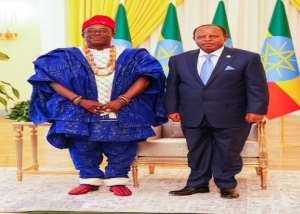
In a landmark diplomatic ceremony held at the Ethiopian Presidency on Tuesday, His Excellency McArios Akanbeanab Akanbong, Ghana’s newly appointed Ambassador to Ethiopia, Permanent Representative to the African Union (AU) and the United Nations Economic Commission for Africa (UNECA), formally presented his Letters of Credence to His Excellency Taye Atske Selassie Amde, President of the Federal Democratic Republic of Ethiopia.
The occasion marked the official commencement of Ambassador Akanbong’s diplomatic mission, where he was warmly received by President Amde, who recalled his own tenure in Accra nearly four decades ago while serving with the International Atomic Energy Agency (IAEA) at the Ghana Atomic Energy Commission. The historical connection underscored the deep-rooted historical ties between the two nations, setting a positive tone for the new chapter in their bilateral relationship.
President Amde, in his remarks, praised Ghana’s influential role on the African continent and in global governance, emphasizing the country’s reputation as a beacon of stability, progressive leadership, and pan-African solidarity. He commended the longstanding diplomatic and economic partnership between Ghana and Ethiopia, urging Ambassador Akanbong to foster even greater cooperation in areas such as trade, investment, and regional integration.
The Ethiopian leader also congratulated the new envoy on his appointment, expressing confidence in his ability to strengthen bilateral relations and advance mutual interests during his tenure. His words echoed Ethiopia’s commitment to deepening Africa’s collective progress, aligning with Ghana’s own strategic priorities under the Reset Agenda of President John Dramani Mahama.
In his detailed address to President Amde, Ambassador Akanbong acknowledged Ethiopia’s commendable strides in democratic governance, particularly highlighting the peaceful and transparent conduct of the country’s federal elections on June 1, 2026. He described Ethiopia as a model of democratic resilience, reinforcing the potential for increased collaboration between the two nations.
A key focus of the Ambassador’s remarks was the economic potential between Ghana and Ethiopia, which currently stands at approximately 3 million US dollars annually—a figure he described as underutilized given the vast opportunities for growth. He urged the activation of key agreements, including:
1. The General Cooperation Agreement (2015) – A framework designed to expand political, economic, and cultural exchanges between the two countries.
2. The Memorandum of Understanding (MoU) on Political Consultations (2015) – A mechanism to enhance diplomatic dialogue and strategic alignment on continental and global issues.
3. The Draft Agreement on Cooperation in Education (Submitted July 8, 2023) – A critical initiative to strengthen academic and vocational exchanges, yet to receive a formal response from Ethiopian authorities. Ambassador Akanbong expressed concern over the delay and called for urgent consideration to facilitate student and faculty mobility, joint research, and institutional partnerships.
Ambassador Akanbong detailed Ghana’s Reset Agenda, a comprehensive governance and economic reform framework spearheaded by President Mahama. The agenda is structured around three core pillars:
– Accountable Governance – Strengthening institutional transparency, anti-corruption measures, and citizen-centric policy implementation.
– Infrastructure Development – Investments in transport, energy, and digital connectivity to boost productivity and regional integration.
– Economic Diversification – Promoting agricultural modernization, industrialization, and job creation to reduce dependency on commodity exports and stimulate inclusive growth.
The Ambassador highlighted that 18 months into the administration, the Reset Agenda has garnered broad approval from both domestic stakeholders and the international community, signaling renewed confidence in Ghana’s development trajectory. He emphasized that Ethiopia’s experience in large-scale infrastructure projects—such as the Grand Ethiopian Renaissance Dam (GERD)—could serve as a valuable model for Ghana’s own infrastructure ambitions.
Concluding his address, Ambassador Akanbong expressed gratitude to President Amde for the opportunity to present his credentials, while affirming Ghana’s commitment to strengthening ties with Ethiopia. He envisioned a future where both nations play pivotal roles in advancing African integration, particularly through:
– Enhanced trade and investment flows to reduce economic disparities across the continent.
– Joint advocacy for African-led solutions in climate change mitigation, conflict resolution, and sustainable development.
– Cultural and people-to-people exchanges to deepen mutual understanding and cooperation.
The Ambassador’s optimism was clear: by leveraging existing agreements, addressing bureaucratic delays, and aligning strategic priorities, Ghana and Ethiopia could transform their bilateral relationship into a cornerstone of Africa’s collective progress.
Image Source: GHANAMMA