Noguchi Achieves HIV Therapy Breakthrough
Ghana’s Noguchi Memorial Institute for Medical Research (NMIMR) has announced a potentially groundbreaking discovery in HIV treatment, involving herbal compounds extracted from native plants. If further testing proves successful, the research could significantly alter the landscape of HIV care.
Scientists at the institute have developed a therapy that, in laboratory tests, demonstrates a high selectivity index – meaning it targets and destroys the HIV virus while leaving healthy cells unharmed. This contrasts with current antiretroviral therapies (ARTs), which, while effective at suppressing the virus, can lead to liver and kidney complications requiring regular monitoring.
“This is going to eliminate the need for that because we have a healthy product,” Dr Adriel Cyrus Moodley, lead rapporteur for Track ‘A’ at the 2025 International Conference on AIDS and STIs in Africa (ICASA), stated in an interview. “That’s something I haven’t heard of because instead of using synthesised products, this herbal study or herbal extract of the plant is nature. The compound exists in the plant, so we do not need to create it.”
Dr Moodley explained that the herbal extracts, currently identified only by code names pending full publication, are naturally occurring and avoid the complexities and potential side effects associated with synthesised drugs. “We’re not out here synthesising things with all of the 10,000 side effects that come from making specific molecules. These are extracts that come naturally. They are synthesised within the plant itself,” he added.
While laboratory testing is complete, Dr Moodley emphasized that animal trials are the next crucial step. Positive results from these trials will pave the way for further research and potential clinical application.
Despite the excitement surrounding the Noguchi Institute’s research, Dr Moodley was quick to point out that ARTs remain the primary and affordable method for managing HIV. He acknowledged their effectiveness in suppressing viral replication but noted the long-term commitment required for treatment.
“ARTs suppressed viral replication, and although they were good, they came with the burden of taking medications long term. HIV at this moment remains incurable despite ART advancements,” he said.
The discovery, Dr Moodley revealed, works by blocking and locking away the HIV virus, a different mechanism than simply halting its replication. “That’s awesome! I’ve been treating HIV for 15 years. I’ve never heard of such a thing in my life. That’s why it’s so exciting,” he exclaimed.
Dr Moodley, a general practitioner from South Africa, advocated for a renewed focus on herbal medicine, specifically identifying and refining active ingredients in plants. He cautioned against excessive manipulation of these natural compounds.
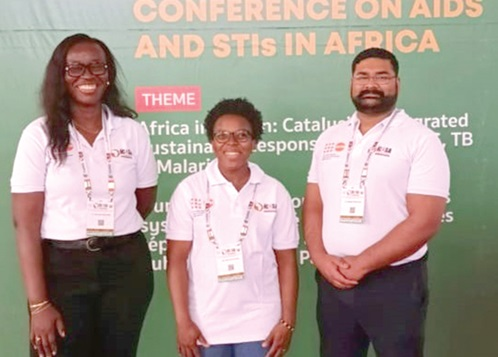
The research was presented at ICASA, which Ghana hosted from December 3 to 8. Dr Moodley’s team included Chief Research Assistant, Diana Asema Asare, and Research Fellow, Dr Nana Afia Asante Ntim, both from the Noguchi Institute. Dr Moodley also highlighted other significant African research, including the first HIV clinical trial on the continent, Treg cell immunotherapy, and advancements in TB co-infection detection.
Looking ahead, Dr Moodley expressed optimism that a cure for AIDS could be within reach by 2030, urging continued investment in multimodal research approaches.
Image Source: MYJOYONLINE