Trump’s Portrait Appears on Limited‑Edition US Passport for 250th Anniversary
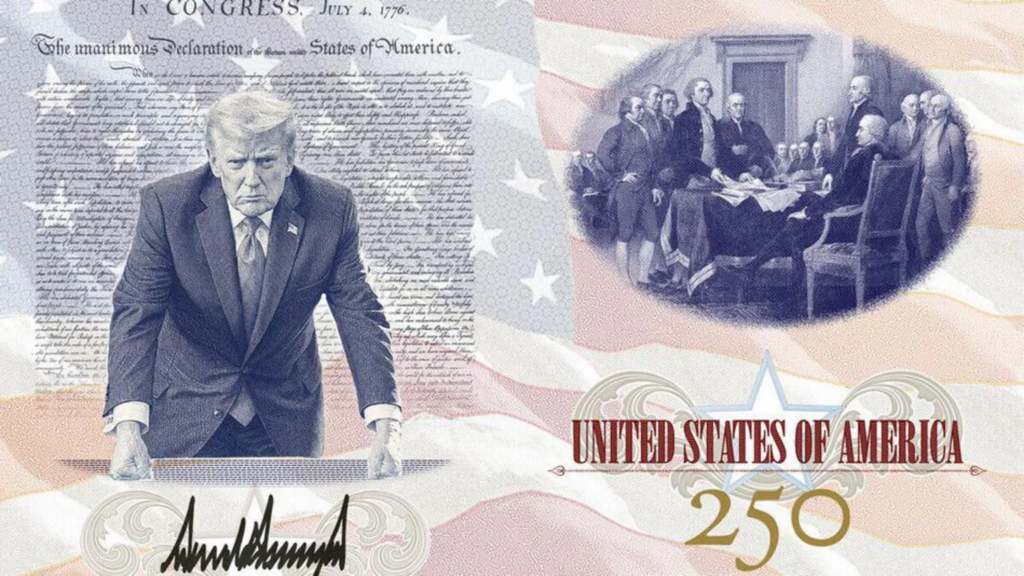
The Trump administration has unveiled a limited‑edition United States passport bearing a portrait of former President Donald Trump, marking the nation’s 250th anniversary with a design that places the incumbent’s likeness on an official travel document for the first time in history. The commemorative passport, announced via Trump’s Truth Social account and subsequently shared by the White House, features an image of the president with his fists planted on the Resolute Desk, the Declaration of Independence visible in the background, and his signature etched beneath the illustration. The State Department confirmed that the special edition will become available on 6 July and will be issued only while supplies last, requiring applicants to appear in person at the Washington Passport Agency or at a handful of designated acceptance events.
Beyond the immediate novelty, the move fits into a broader pattern of the Trump presidency seeking to embed personal iconography onto federal symbols. Over the past few years, the administration has pursued efforts to inscribe the president’s name on government buildings, websites, and official stationery. Earlier in 2026, the administration announced plans for a commemorative gold coin depicting Trump as part of the semiquincentennial celebrations, and officials have hinted that his signature may soon appear on Federal Reserve notes. The passport initiative, however, represents the first instance of a sitting president’s portrait gracing a document carried by millions of citizens for international travel.
Critics warn that blending political imagery with essential travel documents risks eroding the perceived neutrality of passports, which traditionally showcase national symbols such as the Statue of Liberty, the Moon landing, and other unifying motifs. Legal scholars note that while the executive branch possesses authority over passport design, the use of a living politician’s likeness could raise questions about the separation of campaign imagery from state functions. Supporters, meanwhile, frame the passport as a patriotic tribute that celebrates American history through the lens of its current leader, arguing that the limited‑edition nature of the release preserves the special‑edition character without disrupting the standard passport circulation.
The State Department has stressed that access remains highly restricted. Applicants cannot submit requests online or by mail; instead, they must schedule an in‑person appointment at the Washington Passport Agency or attend one of the few special acceptance events currently listed on the department’s website. Whether those attending the agency will be offered a choice between the commemorative edition and the regular passport remains unclear, adding a layer of procedural uncertainty to the rollout.
As the United States approaches its 250th birthday, the debate over how to balance historical commemoration with institutional impartiality is likely to intensify. The Trump passport serves as a focal point for discussions about the appropriate limits of presidential branding on the symbols that facilitate citizens’ movement across borders.