KAIPTC Deputy Commandant Calls for Evidence-Based Approach to West Africa’s Security Threats
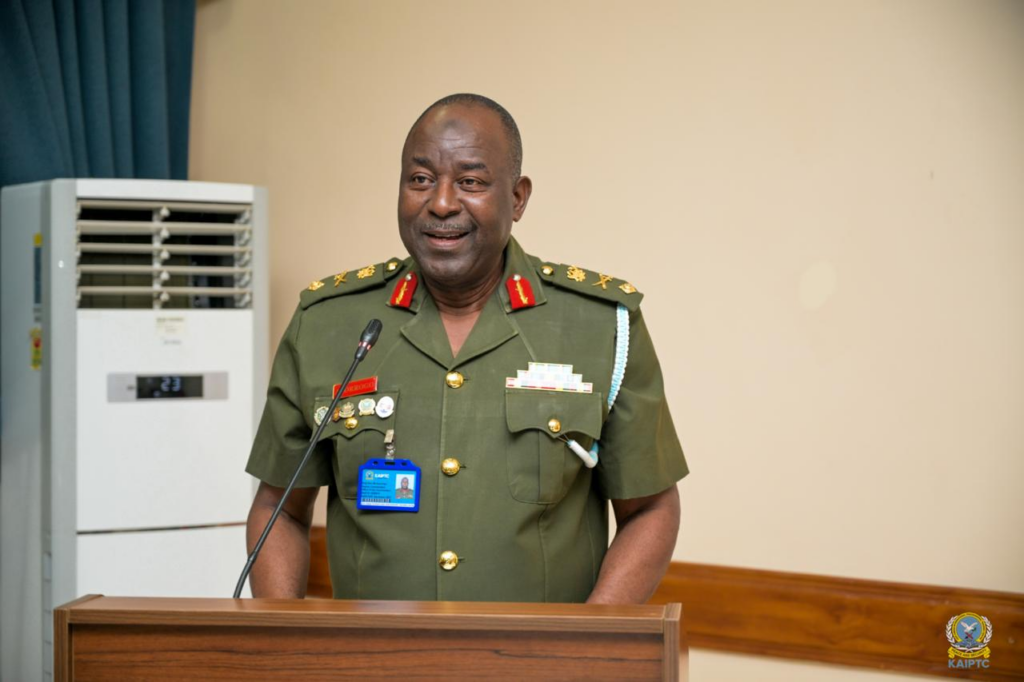
The Deputy Commandant of the Kofi Annan International Peacekeeping Training Centre has called for a fundamental shift in how West Africa responds to its growing security threats, urging governments and partners to ground their interventions in rigorous evidence rather than reactive postures.
Brigadier General Zibrim Ayorrogo made the remarks on June 18 at KAIPTC’s Partners’ Meeting in Accra, where senior officials, researchers, and development partners gathered to discuss the centre’s institutional reforms and future strategic direction.
“These are not abstract concerns confined to security briefings,” Brig. Gen. Ayorrogo said, stressing that instability across the sub-region has direct and measurable consequences for livelihoods, development prospects, and human security more broadly.
The Deputy Commandant’s call comes amid a regional environment that has grown markedly more volatile. Violent extremist networks have spread from the Sahel into coastal West African states, a series of unconstitutional changes of government have destabilised governance structures, and compounding humanitarian crises continue to displace millions.
“We call for responses that are not only informed by robust evidence but are also sufficiently agile to match the pace and complexity of emerging threats,” he told the assembled partners.
KAIPTC’s push toward evidence-based security policy is being operationalised through a significant institutional restructuring. The centre has split its former Faculty of Academic Affairs and Research into two specialised units: a standalone Academic Faculty and a new Department of Applied Research and Innovation in Peace and Security, known as DARIPS.
The restructuring, anchored in KAIPTC’s 2024-2028 Strategic Plan, is designed to sharpen institutional focus and improve the centre’s ability to deliver both academic training and applied research in a more targeted manner. The reform echoes concerns raised by KAIPTC’s own Research Director, who has defended the structural split as essential to countering fast-moving security threats across the region.
DARIPS will operate through four thematic programmes that reflect the interconnected nature of current threats: conflict, governance and leadership; technology and security; climate security and migration; and peace operations, stabilisation and peacebuilding.
Dr. Emma Birikorang, who leads DARIPS as its founding Director, underscored the collaborative nature of the work ahead. “Effective responses to West Africa’s security challenges require coordinated action involving governments, development partners, research institutions and civil society actors,” she said.
The Partners’ Meeting also served to acknowledge the role of long-standing international supporters. Brig. Gen. Ayorrogo expressed particular appreciation for the Government of Germany and the Deutsche Gesellschaft für Internationale Zusammenarbeit, both of which have been instrumental in facilitating training, research, and policy engagement at the centre.
The Deputy Commandant framed the reforms not as a departure from KAIPTC’s established mandate but as an opportunity to deepen partnerships and strengthen the centre’s contribution to peace and security across West Africa and beyond.
Image Source: MYJOYONLINE