West African Forces Deploy to Benin for Post-Coup Stabilization
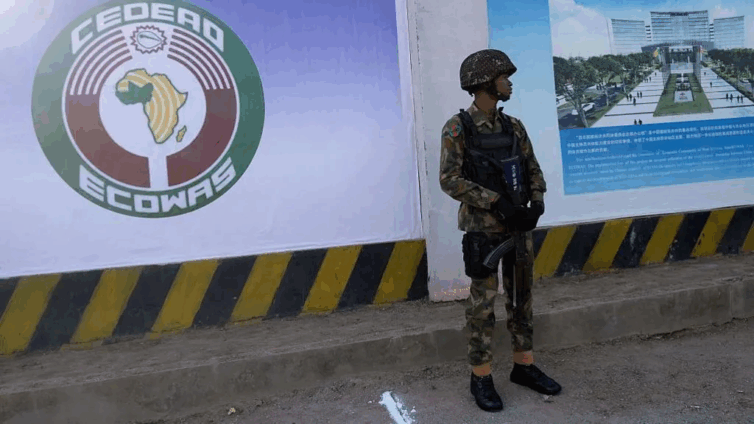
Around 200 West African soldiers, primarily from Nigeria and Ivory Coast, remain in Benin to bolster the government following the thwarted coup attempt on Sunday.
The coup was quelled after Nigeria swiftly deployed fighter jets, successfully driving the mutineers away from a key military base and the state broadcaster, where they had announced a takeover. This marks the first official confirmation of the number of foreign troops involved, though it remains unclear if any have been withdrawn.
Benin’s Foreign Affairs Minister, Olushegun Adjadi Bakari, revealed on Thursday that some regional forces continue to participate in a sweep and cleanup operation. “There are currently around 200 soldiers present, who came to lend a hand… as part of the sweep and cleanup operation,” he stated while addressing journalists in Abuja, Nigeria.
A manhunt is currently underway for the individuals involved in the plot, with reports suggesting the coup leader has sought refuge in neighbouring Togo. The rebel soldiers had voiced grievances over President Patrice Talon’s handling of the deteriorating security situation in northern Benin.
The intervention came as part of a broader deployment by the Economic Community of West African States (ECOWAS), which mobilized troops from Nigeria, Ghana, Sierra Leone, and Ivory Coast to secure vital installations and prevent further unrest. Nigeria emphasized its response as a firm stance against any assault on democracy.
According to an Ivory Coast security source who spoke to AFP news agency, 50 soldiers from their country were dispatched as part of the regional effort. Minister Bakari clarified that by the time ECOWAS assistance was requested, Beninese forces had already regained control. “When we started discussions… our military had already pushed them back,” he explained.
He further noted that the aerial support provided by Nigeria was crucial for a precise operation aimed at neutralizing the rebels without endangering civilians. “What was required was precise aerial backup to carry out a surgical operation,” Bakari added.
Nigeria’s Foreign Affairs Minister, Yusuf Maitama Tuggar, highlighted the swift diplomatic, military, and intelligence collaboration between the two nations as key to the coup’s failure. Discussions are ongoing regarding the duration of the regional forces’ stay, with any decision to be made in close consultation with Benin’s defence and security forces, who have been commended for their bravery.
The involvement of French special forces in assisting loyalist troops remains unconfirmed, with their current status in Benin unclear. ECOWAS, facing mounting pressure due to recent coups in the region, is signalling a zero-tolerance policy towards military overthrows of democratically elected governments.
“ECOWAS is an important tool that allows us to defend democracy and the values of democracy in our regional space,” Bakari praised.
Benin’s military has faced challenges in its northern border region, battling jihadist militants linked to Islamic State and al-Qaeda who have been expanding southwards. President Talon, a Western ally, is scheduled to step down next year after completing his second term, with elections planned for April.
Image Source: MYJOYONLINE