UNEA-7 Unveils Global Plan to Combat Climate Change and Protect Biodiversity
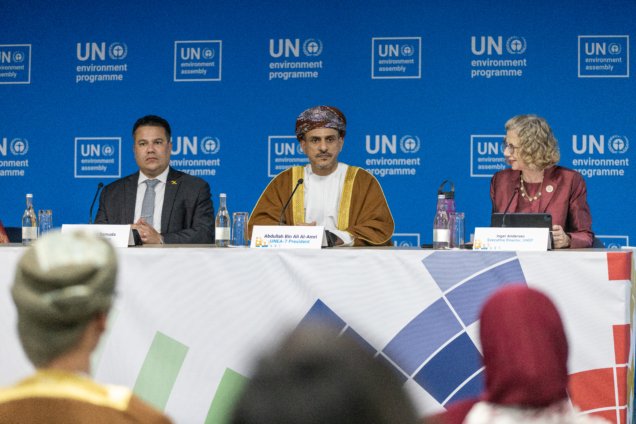
The seventh session of the United Nations Environment Assembly (UNEA-7) concluded on Friday with Member States adopting 11 resolutions, three decisions, and a ministerial declaration. These commitments aim to tackle the interconnected global crises of climate change, biodiversity loss, land degradation, and pollution.
Key resolutions focus on bolstering international collaboration to combat wildfires, strengthening responses to antimicrobial resistance’s environmental impacts, protecting vulnerable glaciers, and addressing the challenges posed by sargassum seaweed blooms.
Beyond these, agreements were reached on safeguarding coral reefs, responsibly managing minerals crucial for the energy transition, enhancing chemical and waste management, promoting sustainable Artificial Intelligence, and leveraging the power of sport for environmental solutions.
Abdullah bin Ali Al-Amri, President of Oman’s Environment Authority and President of UNEA-7, emphasized the significance of the outcomes. “What has been achieved here proves that this bridge is indeed capable of carrying the world’s ambitions towards a better future,” he stated.
He cautioned that the real test lies in implementation. “The end of the session does not mean the end of the work. Success will not be measured only by what has been agreed on paper but by real change in people’s lives,” Al-Amri explained. He envisions this change manifesting as cleaner air and water, restored ecosystems, green job creation, and more resilient communities.
The week-long Assembly drew over 6,000 participants from 186 nations to the UNEP headquarters in Nairobi. Alongside the resolutions, UNEP’s Medium-Term Strategy (MTS) for the next four years and its Programme of Work for the next two years were also approved.
Inger Andersen, UNEP Executive Director, urged Member States to fully support UNEP’s efforts. “You will now return to the world outside the negotiation halls—a world in which, let us not forget amid our euphoria, people are dying, homes and livelihoods are being destroyed, economies are being damaged and inequity is growing because action on environmental challenges has not been fast or strong enough,” she warned.
Ms. Andersen added, “Yes, you have brightened the beacon and better lit the path forward. But we must now, together, hurry down this path to deliver real solutions for a resilient planet and resilient people.”
UNEA-7 also featured the second Multilateral Environmental Agreements Day, focusing on international cooperation in environmental governance. The seventh Global Environment Outlook report was released during the Assembly, revealing that investments in climate stability, healthy ecosystems, and pollution reduction could generate trillions in economic growth, prevent millions of deaths, and alleviate poverty and hunger.
Prior to the main Assembly, a Youth Environment Assembly brought together over 1,000 young delegates, advocating for greater youth involvement in environmental decision-making. A Cities and Regions Summit highlighted the crucial role of local governments in implementing environmental solutions.
Civil society groups contributed through the 21st Global Major Groups and Stakeholders Forum, sharing their perspectives with Member States and UNEP. The Assembly also celebrated the 2025 UN Champions of the Earth Awards and the latest UN World Restoration Flagships, with UNEP Goodwill Ambassadors participating to raise awareness.
Jamaica’s Minister of Water, Environment and Climate Change, Matthew Samuda, was elected President of UNEA-8. “Our voices carry the weight of communities on the frontlines of climate impacts—communities that cannot afford delay and do not have the luxury of indifference,” Mr. Samuda stated.
He pledged a focus on inclusion, transparency, and practical action during his leadership. “We must work to strengthen the science-policy interface, scale up financing for adaptation and resilience, and accelerate the transition to sustainable production and consumption systems. And we must do so while ensuring that no state—large or small—feels excluded from the solutions we craft,” he said.
UNEA-8 is scheduled to take place from December 6 to 10, 2027, at the UNEP headquarters in Nairobi.
Image Source: MYJOYONLINE