Trump Pledges to Make US More Affordable Amid Financial Strains
President Donald Trump has asserted that consumer prices in the United States are falling “tremendously,” as he attempts to reassure voters concerned about the rising cost of living.
Speaking at a campaign-style rally held at a casino in Pennsylvania, a key battleground state, on Tuesday, President Trump declared that making America affordable again was his “no higher priority.”
While prices of some goods like fuel and eggs have seen a decrease, many Americans continue to grapple with higher costs for essential items such as food, housing, childcare, and healthcare. This economic anxiety has become a focal point for Democrats, who have successfully leveraged it in recent state and city elections, causing unease within Republican ranks ahead of next year’s midterms.
The rally in Pennsylvania marked the first in a planned series of events by the White House, aimed at communicating its economic message directly to voters. However, during his address, President Trump again dismissed concerns about affordability, labelling them a Democratic “hoax.”
The White House has consistently blamed former President Joe Biden’s policies and the interest rate decisions of the US central bank for the ongoing economic challenges. The Federal Reserve has implemented two rate cuts, bringing rates down to approximately 3.9%, with financial markets anticipating further reductions on Wednesday.
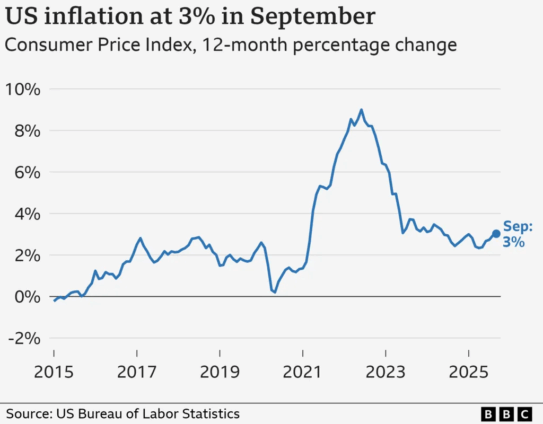
Despite these measures, inflation remains above the Fed’s 2% target, currently standing at 3%. In recent weeks, the Trump administration has taken steps such as removing tariffs on numerous food products and promoting the rollback of fuel efficiency standards, alongside the introduction of Trump-branded retirement accounts for children, as potential solutions to ease the burden on consumers.
When asked by Politico to assess the economy, President Trump responded with an emphatic, “A plus-plus-plus-plus-plus.” A recent Reuters/Ipsos poll indicated a slight improvement in his approval rating, rising three points to 41%, potentially reflecting the impact of these policy adjustments.
However, many Americans remain pessimistic about the economic outlook. Alaina Hunt, 37, shared her experience with the BBC, explaining that she lost her job as a designer in Oklahoma City in April, partly due to the impact of Trump’s tariffs on steel and aluminium. “The construction sector really took a hard hit very early on,” she stated, adding that she had submitted over 75 job applications without success. She also noted a $25 weekly increase in her grocery bills, making it harder to make ends meet. “I was able to scrape by a lot easier in years before,” Ms Hunt said, expressing her belief that “the federal government is not listening at all.” She voted for Kamala Harris in 2024.
Pennsylvania Governor Josh Shapiro, a Democrat, voiced skepticism regarding President Trump’s economic messaging. He told CBS News that the president’s optimistic view “does not reflect the reality on the ground here in a community where many Pennsylvanians voted for him in the last election.” Governor Shapiro highlighted the detrimental effects of trade tariffs, stating, “The record is clear: his policies have hurt the very communities that propelled him to the White House.”
Economic data presents a mixed picture. US consumer confidence dipped in November to its lowest level since the spring. Conversely, the stock market remains near record highs, and forecasts predict economic growth of 1.9% this year, slower than the previous year’s 2.8% but still positive. Recent data also suggests a potential rebound in the job market after a period of slowdown.
At the rally, President Trump reiterated that “prices are coming down tremendously from the highest prices in the history of our country.” However, economists point out that while the rate of price increases is slowing – a phenomenon known as disinflation – prices are not actually falling. As of September, inflation stood at 3%, unchanged from January when President Trump took office, and still exceeding the Federal Reserve’s 2% target.
Over the past five years, overall prices have increased by 25%, contributing to widespread frustration despite wage growth during the same period. Beth Richardson, 45, from Kansas, recounted her shock at the price of a pack of Mentos gum, which cost almost $5 with tax. “I’m like, I’m just going to go die now because this cannot be,” she said. Ms Richardson lost her job in sales support at a tech company in late 2023 due to job relocation overseas and voted for Kamala Harris last year. She believes President Trump’s policies, including tariffs, are “shooting ourselves in the foot.”
Despite the economic pressures, many of President Trump’s supporters remain steadfast. John Mohring, 60, a construction worker from Kenosha, Wisconsin, has supported Trump since 2016. He acknowledged that grocery prices began rising before President Trump’s return to office and haven’t decreased significantly, now spending around $100 weekly on groceries. However, he continues to support the administration’s tariffs and border policies, stating, “I’m giving him the benefit of the doubt.”
Brad Smith, a farmer from Illinois, initially suffered losses when China halted soybean purchases amid a trade dispute. However, he noted a recent recovery following a trade agreement and China’s resumption of some purchases. President Trump also announced a $12 billion aid package for US farmers. Mr Smith expressed continued faith in the president’s economic plans, stating, “There’s probably bigger things at play other than just the soybean and corn market,” and adding, “The whole America First idea is good.”
Image Source: MYJOYONLINE