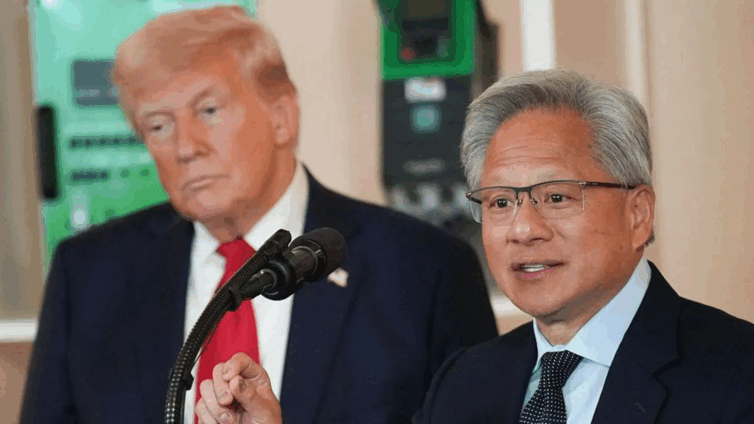
US President Donald Trump said on Monday he will permit AI‑chip maker Nvidia to sell its H200 chips to approved customers in China, a move he billed as protecting national security and creating American jobs.
The Department of Commerce will vet each buyer, and the waiver also extends to other US chip firms such as AMD, after intensive lobbying by Nvidia chief Jensen Huang, who visited Washington last week.
Trump’s reversal follows a July decision that lifted a ban on Nvidia’s most advanced chips but required the company to remit fifteen percent of its Chinese revenues to the US Treasury.
“We applaud President Trump’s decision to allow America’s chip industry to compete to support high‑paying jobs and manufacturing in America,” Nvidia said in a statement to BBC News.
For Ghana, the policy could ease the supply of high‑performance AI hardware for local data‑centres and fintech startups that rely on imported chips, potentially lowering costs for companies such as Ghana‑based mPharma and let the country deepen its role in the global AI supply chain.
Alex Capri, senior lecturer at the National University of Singapore, noted that allowing limited H200 sales may buy time for the United States to negotiate a rare‑earths deal with Beijing, given China’s near‑monopoly on the minerals essential for semiconductor production.
Researchers at Georgetown University’s Center for Security and Emerging Technology warned that the People’s Liberation Army is already using US‑designed chips to develop AI‑enabled military capabilities. “By making it easier for the Chinese to access these high‑quality AI chips, you enable China to more easily use and deploy AI systems for military applications,” said Cole McFaul, senior research analyst at CSET.
The arrangement is expected to face scrutiny from national‑security hawks in the US Congress, and the White House has yet to clarify the exact revenue‑sharing mechanism, with Trump indicating that twenty‑five percent will be paid to the United States.
Ghana’s Ministry of Communications will monitor the development closely, assessing both the economic upside for the local tech ecosystem and the broader security implications of tighter US‑China tech ties.
Image Source: MYJOYONLINE