Ghana Turns Trash into Power to Save Lives
Every morning, smoke rises across homes and markets in Ghana’s Ahafo Region, a stark reminder of the reliance on charcoal stoves and firewood for millions of families. This smoke, while a traditional sight, poses a significant threat to public health.
Researchers are now highlighting a troubling paradox: communities in towns like Sunyani and Duayaw Nkwanta are choking on smoke while simultaneously surrounded by a potential solution – waste. Crop residue, sawdust, and other organic waste, often burned or discarded, could be transformed into clean energy, offering a path towards healthier lives and forest conservation.
For women like Gloria Obeng, a food vendor in Duayaw Nkwanta who has been cooking with firewood for 27 years, the choice isn’t about preference, but survival. “I have been told many times that the smoke is not good for my health,” Gloria says. “But if I stop cooking, I stop eating. This work is what keeps me alive.”
The World Health Organisation (WHO) identifies household air pollution from firewood and charcoal as a leading cause of respiratory diseases globally, with women and children disproportionately affected. Halima Yussif, another resident, echoes Gloria’s sentiment. “The doctors said I should stop because of my health,” she says. “But I have been stubborn. I don’t have any other option.”
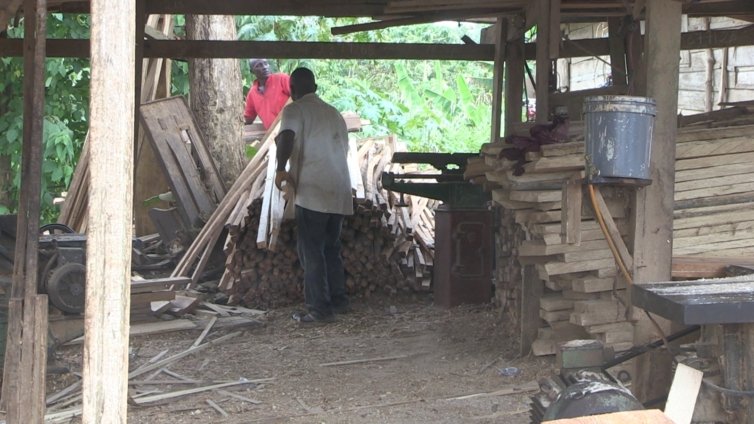
While families struggle with the health impacts of smoky kitchens, a different problem is brewing just kilometres away. Sawmills across the Ahafo and Bono regions are accumulating large piles of sawdust. Nicholas Afriyie, owner of Nicho Enterprise, explains, “We burn the sawdust most of the time. Sometimes it becomes a burden to us. We didn’t know it could be used to produce energy.” He adds, “If someone wants the sawdust to convert it into energy, I am ready to give it out. It will even help us.”
In Sunyani, the Municipal Environmental Health Officer, Daniel Owusu Korkor, says the burning of waste is prohibited. “We assist businesses to convey the accumulated sawdust to the final disposal site to be reprocessed into organic manure,” he insisted. The Assembly, he added, encourages residents to report illegal waste burning, with officers dispatched to investigate.
A 2019 study by researchers from Ghana and Germany – Fabian Präger, Sebastian Paczkowski, Gregor Sailer, Nana Sarfo Agyemang Derkyi, and Stefan Pelz – revealed that Sunyani possesses ample unused biomass, including crop waste, sawdust, animal manure, and organic waste. “Our study shows that Sunyani has enough unused biomass to meet a significant part of its energy demand if the right technology and training are provided,” the researchers stated.
Dr Gifty Serwah Mensah, a lecturer at the Department of Renewable Energy Engineering at the University of Energy and Natural Resources in Sunyani, emphasizes the environmental benefits. “When organic waste is left to rot, it produces methane,” she says. “Methane is about 20 times more potent than carbon dioxide in warming the climate.” She explains that waste-to-energy technologies like anaerobic digestion and fermentation can capture this methane and convert it into usable energy, while also turning garden waste and forest residues into pellets for clean cookstoves.
The adoption of biomass energy in these communities promises a multitude of benefits: cleaner air, improved health outcomes, new income streams for farmers, and the preservation of Ghana’s forests. “Every tree that is cut down reduces the forest’s ability to absorb carbon dioxide,” Dr Mensah explains. “By producing energy from waste, we reduce deforestation and carbon emissions at the same time.”
A community leader stated, “If we get support, we will adopt biomass quickly. We want clean air for our children and protection for our forests.” Researchers are urging the government, traditional authorities, and development partners to collaborate on promoting biomass energy through community education, technology investment, and financial incentives.
The solution to this energy and health crisis is within reach. Turning waste into energy isn’t just a possibility; it’s a necessity for a healthier and more sustainable future for the people of Ahafo and Bono regions.
This article is part of a collaborative project between JoyNews, CDKN Ghana, and the Centre for Climate Change and Sustainability at the University of Ghana, with funding from the CLARE R41 Opportunities Fund.
Image Source: MYJOYONLINE