Portugal Faces Mass Disruption in First General Strike Since 2010
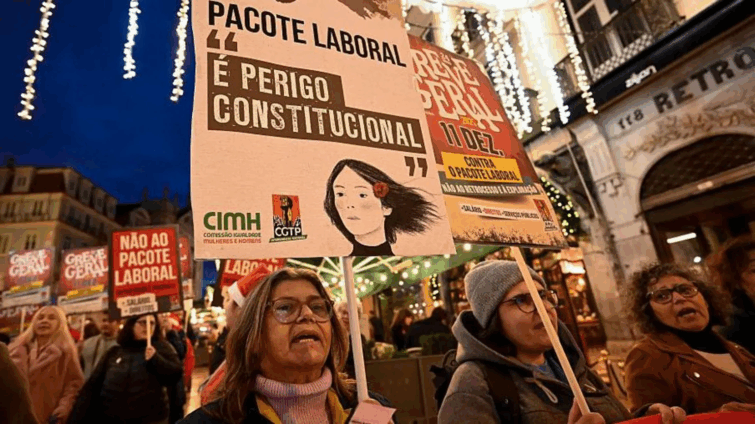
Portugal is experiencing widespread disruption today, Thursday, as a general strike cripples transport, flights, hospitals, schools, and other essential public services. The action is being led by the country’s two major union federations in protest against sweeping labour reforms proposed by the government.
This is the first time in twelve years that the CGTP and the UGT have jointly called a general strike. The last such unified action occurred in 2013, during the height of the eurozone debt crisis, when international lenders demanded austerity measures including cuts to salaries and pensions.
Despite Portugal’s recent economic growth – currently the fastest in the Eurozone – Prime Minister Luís Montenegro insists that changes to the labour market are necessary. He argues that these “rigidities” must be addressed to boost company profitability and, ultimately, improve workers’ wages.
“I will not give up on having a country with the ambition to be at the forefront, to be at the vanguard of Europe,” Montenegro stated on Wednesday.
However, the Prime Minister appears to have underestimated the level of opposition to his plans. Remarkably, even a member of his own Social Democrat party, who also sits on the UGT executive, voted in favour of the strike.
Montenegro made some concessions following talks with the unions late last month, but these proved insufficient to avert the industrial action. Key proposals sparking outrage include provisions allowing employers to repeatedly renew temporary contracts, lifting restrictions on dismissing workers only to rehire them through outsourcing, and removing the obligation to reinstate unfairly dismissed employees.
The reforms are expected to disproportionately affect young Portuguese workers in their 20s, a demographic with already precarious employment conditions. Opinions are divided, with some supporting the changes as a necessary step towards economic modernization.
“It has to be done. We have to catch up with richer countries and with these measures I think we can evolve more,” said Diogo Brito, an air steward, who believes the reforms are positive.
Conversely, Eduardo Ferreira, a self-employed photographer, expressed solidarity with the striking workers, stating: “Things have been tough ever since the troika, and workers haven’t reacted until now.” He welcomed the unions’ united front at what he described as a “critical moment” for Portugal.
The CGTP has labelled the proposed reforms an “assault on the rights of all workers, particularly women and young people,” while the UGT contends that the package is “so out of step” with the current economic climate – characterized by growth, stability, and a strong labour market – that it clearly favours employers.
The UGT further criticized the government’s consultation process as “unbalanced, restrictive and detrimental to workers”.
Montenegro’s coalition government currently lacks a parliamentary majority and is actively seeking support for the bill. Negotiations are underway with both the small, free-market Liberal Initiative (IL) and the hard-right Chega party, which has become the second-largest political force in Portugal.
André Ventura, the leader of Chega, has voiced concerns about the potential impact of some measures on family life, but appears open to negotiation. This has drawn criticism from unions and the Socialist party, who accuse Montenegro of abandoning his pre-election stance against cooperating with Chega.
Concerns are also growing that right-wing politicians may seek to amend Portugal’s 1976 constitution, which provides strong employment protections. The issue has become intertwined with the upcoming January presidential election, with several candidates challenging the constitutionality of the labour reforms.
Under Portugal’s “semi-presidential” system, the President has the power to veto legislation approved by parliament or refer it to the Constitutional Court for review. This potential scrutiny could fuel public unease about the government’s radical agenda, particularly as the reforms were not included in the coalition’s election manifesto.
The strike is notable for its broad reach, extending beyond the public sector. Employees at Autoeuropa, Portugal’s largest factory and a subsidiary of Volkswagen, voted overwhelmingly in favour of the strike last week.
“I believe there is no worker in this country unaffected by the negative measures in this reform,” declared UGT secretary-general Mário Mourão following the Autoeuropa vote. “It must be responded to appropriately.”
Image Source: MYJOYONLINE