Mankessim Omanhen Declares Lithium Areas Disaster Zones
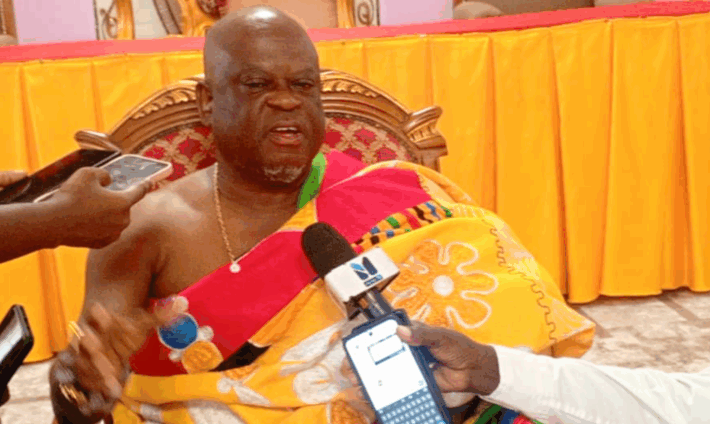
The Omanhen of Mankessim Traditional Area, Osagyefo Amanfo Edu VI, has declared communities affected by lithium exploration within his jurisdiction as “Artificial Disaster Zones,” appealing for urgent national intervention.
The declaration follows the government’s decision to withdraw the lithium mining agreement from Parliament for further stakeholder consultations. This withdrawal comes after a two-year delay in compensating affected residents due to the stalled ratification process.
While acknowledging he wasn’t opposed to the agreement’s withdrawal, the Omanhen expressed concern that the situation had amplified the hardship faced by his people. “The festive season has been eclipsed by hopelessness and a grip of uncertainty in the area,” he stated.
Addressing the press, Osagyefo Amanfo Edu VI painted a grim picture, lamenting the plight of farmers unable to cultivate their lands, and homes threatened by the exploration activities, all without receiving due compensation. “You just picture this,” he passionately conveyed.
He argued that the extended delay wasn’t merely hindering the Atlantic Lithium Company, but was actively damaging the socio-economic wellbeing of his community. “It is strangling our souls, poisoning our prosperity and igniting a ticking time bomb that threatens the very fabric of my people and our nation,” the Omanhen said.
Osagyefo Amanfo Edu VI urged the government to act swiftly, warning that the current situation could lead to widespread disillusionment. He emphasized that the community’s struggles stemmed from governmental delays, not natural causes, creating a unique and pressing humanitarian concern.
The Omanhen also clarified that the agreement’s withdrawal shouldn’t be interpreted as a cancellation of the Ewoyaa Lithium project. He dismissed rumours circulating to that effect as “baseless, unfortunate and unfounded” and urged the public to disregard them.
He explained the withdrawal was prompted by opposition from civil society organizations and industry professionals who advocated for more favorable terms for Ghana. This move, he added, allows the Ministry of Lands and Natural Resources to engage in further consultations, following recent discussions with the Parliamentary Select Committee on Lands and Natural Resources and CSOs.
The initial agreement with Barari DV Ghana Limited (a subsidiary of Atlantic Lithium) proposed a 10 per cent royalty rate, a 13 per cent free carried interest for the state, and plans for value-addition initiatives, including establishing a chemical plant. However, these terms faced criticism from various stakeholders, with some considering the 10 per cent royalty rate insufficient.
The Parliamentary Committee on Lands and Natural Resources reportedly found the proposed 10 per cent rate inconsistent with the current Minerals and Mining Act, which stipulates a five per cent royalty. Amending the Act would be necessary to legally enforce a higher rate.
While advocacy groups welcomed the government’s decision to review the agreement, the Omanhen stressed the immediate need to compensate his people, whose livelihoods had already been disrupted by the exploration activities. “But while waiting for it, my people whose farmlands and homes have been destroyed must be compensated for them to survive,” he emphasized.
Image Source: MYJOYONLINE