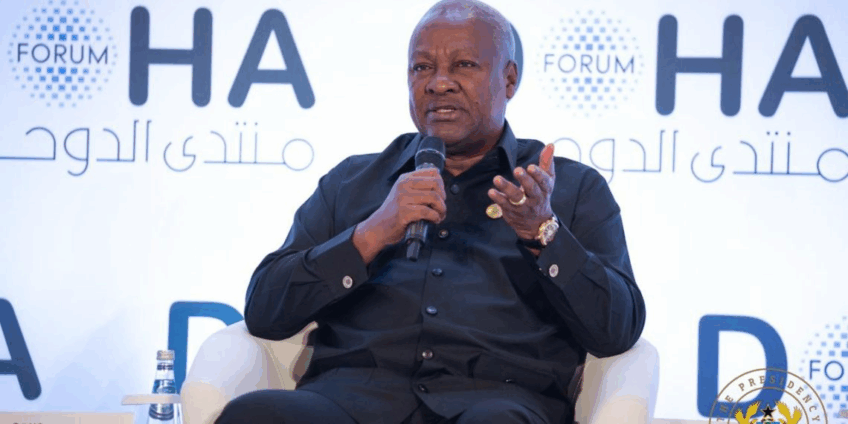
President John Mahama urged Ghana to accelerate domestic financial mobilisation on Tuesday at the 2025 Doha Forum in Qatar, warning that a strong and sustainable education system cannot rely solely on external assistance.
Addressing a gathering of policymakers and development partners, Mahama said international aid remains valuable but “real transformation requires reliable internal funding driven by national ownership.” He highlighted the Ghana Education Trust Fund (GETFund) as evidence that Ghana can finance its own priorities when it chooses to do so.
“At a point in time, we realised that education was a key sector to Ghana’s progress and development, and so as a nation we decided to contribute to everything we purchase the 2.5% VAT, and that goes into the Ghana Education Trust Fund,” Mahama explained. He noted that the 2.5% Value‑Added Tax on goods and services provides a steady stream of resources that can sustain school infrastructure, learning materials and the expansion of tertiary education.
The former president warned that over‑reliance on donors weakens fiscal resilience. “We must strengthen our domestic revenue systems to cut over‑reliance on donors,” he said, adding that consistent internal financing is essential for long‑term progress.
Mahama also turned his attention to agriculture, calling for an overhaul of the country’s farming systems to match fast‑changing climate patterns. He declared that the era of relying mainly on rain‑fed agriculture is over and urged major investment in irrigation to protect farmers and secure food production.
“We need to adapt our agriculture to a new reality. That means we must put more land under irrigation,” he asserted. Acknowledging that many smallholder farmers cannot afford the costs, Mahama said his government has decided to embark on “appropriate and affordable irrigation for the farmers” to raise productivity, create rural jobs, stabilise food supply and strengthen climate resilience.
Mahama’s remarks reflect Ghana’s broader development vision, which centres on domestic resource mobilisation, education reforms and a modern, climate‑resilient agricultural system. He called on all stakeholders to champion national ownership as the pathway to sustainable growth.
Image Source: MYJOYONLINE