Mahama: Education Key to Achieving Sustainable Development Goals
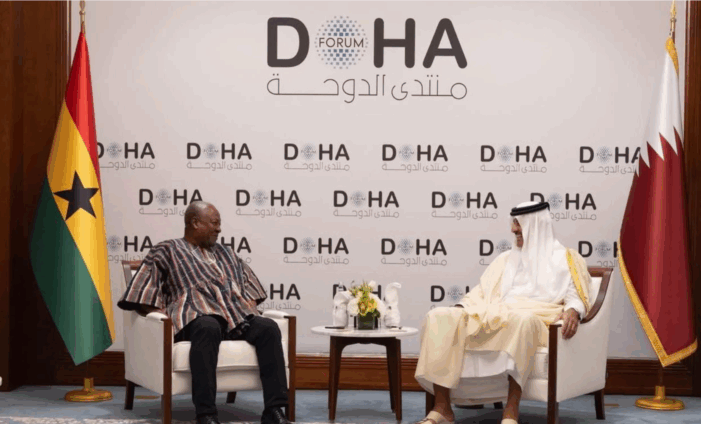
President John Dramani Mahama has emphasized the critical role of education as a cornerstone for achieving the Sustainable Development Goals (SDGs).
The President made these remarks while addressing the 2025 Doha Forum, held under the theme “Justice in Action: Beyond Promises to Progress.” He underscored that education is not merely SDG 4 – Quality Education – but a fundamental enabler for all 17 SDGs.
“Education is not the only focus of SDG 4, quality education, but also the enabler of all the other sustainable goals. Because without education, we cannot end poverty, which is SDG 1,” President Mahama stated.
He further elaborated that progress in areas like good health and well-being (SDG 3), gender equality (SDG 5), decent work and economic growth (SDG 8), climate action (SDG 13), and peace, justice, and strong institutions (SDG 16) are all inextricably linked to access to quality education.
“Education illuminates the path to every other goal and empowers individuals, strengthens institutions and transforms nations,” the President added. He stressed the need for just, equitable, and resilient education systems to build a better world.
President Mahama noted that the Doha Forum’s theme highlighted the global nature of justice, extending beyond national borders. He argued that education is a global public good, and denying learning opportunities to children anywhere in the world diminishes global potential.
To ensure education serves as a vehicle for justice, particularly during crises, the President called for several key commitments. These include protecting education budgets even during economic hardship, integrating education into humanitarian response plans, prioritizing the safety of schools, accelerating digital inclusion through infrastructure and training, supporting teachers, and strengthening global partnerships.
“Our world is changing fast. Our thinking about education must evolve just as rapidly,” he said, emphasizing the need to prepare young people for the challenges of climate change, digital disruption, democratic participation, and a technology-driven global economy.
The President passionately argued that education must be transformational, equitable, and forward-looking. “This is the justice we owe our children,” he stated. He powerfully illustrated this point, saying, “Justice is not only delivered in the courtrooms. Justice lives in the classrooms. It is found in the moment a child learns to read…In the moment, a teacher inspires courage in a new generation.”
Concluding his address, President Mahama urged world leaders to prioritize education as their most significant investment and commitment, echoing the proverb that “knowledge is like a garden. If it is not cultivated, it cannot be harvested.”
“Let us cultivate the seeds of justice through education, especially in times of crisis, so that the harvest may be peace, prosperity and a shared humanity,” he urged.
Image Source: MYJOYONLINE