Mahama Praises Doha Forum for Honoring Alex Thier and Saad Mohseni
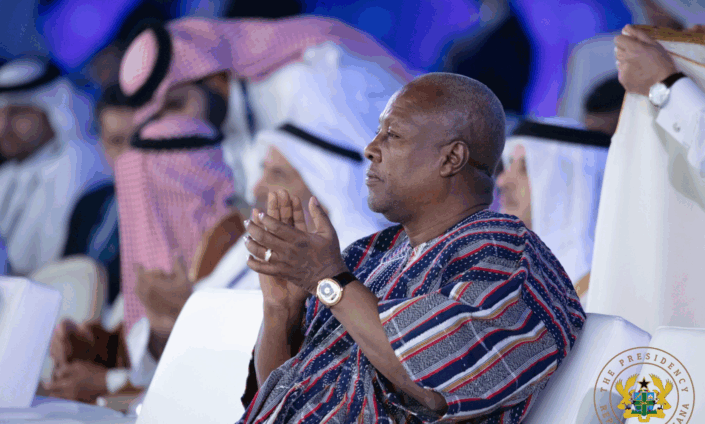
President John Dramani Mahama has lauded the organisers of the 2025 Doha Forum for honouring Alex Thier and Saad Mohseni with this year’s awards.
The President explained that the recognition was in appreciation of the work Mr. Thier and Mr. Mohseni are doing to bridge educational gaps in societies grappling with some of the most severe crises in recent history.
The awards were presented during the opening ceremony of the Doha Forum 2025 on December 6, by the Amir of Qatar, Sheikh Tamim bin Hamad Al Thani. The two individuals were celebrated for their “transformative” contributions to supporting children’s education in challenging environments, specifically in Palestine and Afghanistan.
Delivering his address at the Forum, themed “Justice in Action: Beyond Promises to Progress,” President Mahama spoke on the topic “Education as Justice in Times of Crisis.” He emphasized that even in stable times, policymakers continually seek ways to improve education, making it accessible and relevant in a rapidly evolving world.
He further noted that the need for such reforms is even more critical in nations affected by conflict and displacement. “The disruption of education affecting a current generation of children in Gaza, in Afghanistan, Sudan and elsewhere is an unfolding humanitarian tragedy that will play out for decades to come,” the President stated.
President Mahama highlighted Ghana’s own experience, asserting that nations prioritizing education demonstrate the greatest resilience, even amidst adversity. He pointed to the bold reforms undertaken in Ghana over the past decades to expand educational opportunities and promote justice through learning.
“For example, our free basic and secondary education have enabled millions of Ghanaian youth to access education regardless of their family income,” he said, adding that investments in Technical and Vocational Education and Training (TVETs) and digital literacy are also strengthening early childhood and basic education.
The President recalled the COVID-19 pandemic as a period of global innovation in educational justice. “Schools were closed across the world and countries. Various countries had to innovate and implemented some of the most adaptive education in emergency times. Nationwide radio and TV learning programs were launched,” he recounted.
He noted the deployment of digital learning platforms, the provision of community-based tutoring, and the support offered to teachers to develop new methods of instruction, all aimed at ensuring that learning continued uninterrupted. These measures, he said, were a demonstration of justice, preventing the abandonment of children during a global crisis.
President Mahama underscored that the COVID-19 experience proved that education systems can be built to withstand crises. He stated that classrooms should remain open and serve as anchors of hope, stability, and protection during challenging times.
He also addressed the relevance of this conversation to Africa, where an estimated 30 million children are out of school, and millions more are attending without achieving meaningful learning outcomes. Climate-related emergencies and digital divides further exacerbate these challenges.
The President emphasized that education is not only the focus of Sustainable Development Goal Four (SDG 4), Quality Education, but also a crucial enabler of all other SDGs. “Because without education we cannot end poverty which is SDG 1. Without education we cannot achieve good health and well‑being which is SDG 3. Without education we cannot attain gender equality which is SDG 5,” he stated.
“Without education we cannot build decent work and economic growth which is SDG 8. Without education we cannot strengthen climate adaptation which is SDG 13. And without education we cannot secure peace, justice and strong institutions which is SDG 16.”
He concluded that education empowers individuals, strengthens institutions, and transforms nations, and is therefore fundamental to building a just, peaceful, and prosperous world. “If we want a just, peaceful and prosperous world we must start by ensuring just, equitable and resilient education systems.”
President Mahama reiterated that the Doha Forum’s theme underscores the global nature of justice, emphasizing that education is a global public good. He warned that denying educational opportunities to children anywhere in the world due to conflict or poverty represents a loss of talent, innovation, and potential for all.
Image Source: MYJOYONLINE