Ghana Protects Indigenous Crops in Renewed Sovereignty Drive
A movement to safeguard Ghana’s indigenous seeds is gaining momentum in the farming community of Forikrom, near Techiman. Farmers, scientists, and traditional leaders recently converged for the 2025 Indigenous Seed and Food Festival, aiming to bolster national food security against the backdrop of globalised seed markets and climate change.
The festival wasn’t simply a cultural event, but a strategic alliance between ancestral knowledge and modern science, prompting a re-evaluation of resilience, ownership, and sustainability in Ghana’s agricultural sector.
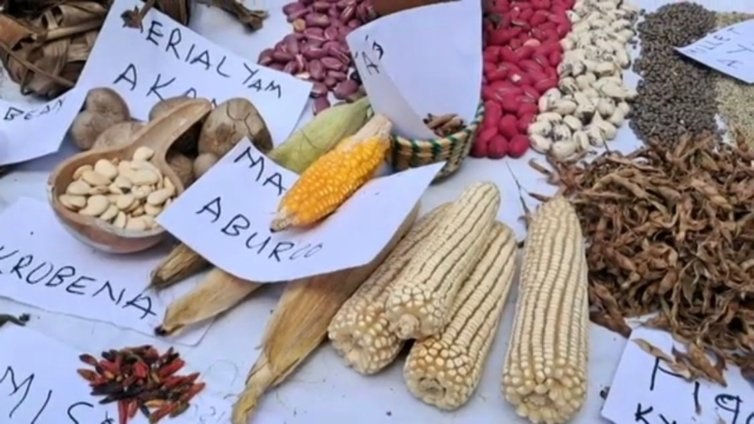
The festival grounds showcased a diverse collection of native millet, cowpea, groundnut, okra, and maize varieties. Each seed represents generations of accumulated farming wisdom, a ‘living museum’ as one reporter at the event described it.
The initiative is spearheaded by a partnership between the Centre for Indigenous Knowledge and Organisational Development (CIKOD), the Council for Scientific and Industrial Research (CSIR), and the Association of Church-Based Development Projects (ABOFAP). CIKOD’s Executive Director, Benjamin Guri, emphasized the critical role of these local seeds.
“These local seeds are not just plants; they are the foundation of our agricultural system,” Mr. Guri said. “They carry the memory of our land. They are resilient, adaptive, and attuned to our climate. They understand the rhythm of our rains and the intensity of our sun.”
He cautioned against the reliance on expensive and structurally dependent imported hybrid seeds, stressing that local seeds are “a national treasure, affordable, accessible and inherently ours.” Mr. Guri called for deliberate policy support to preserve and expand their use.
CSIR is contributing through scientific conservation efforts. Dr. Rashid Tetteh of CSIR explained, “We are here to identify, document and collect valuable indigenous varieties for inclusion in the national seed bank. This is not passive storage. It is a rescue operation—a form of genetic insurance against extinction.”
The festival also received strong backing from traditional authorities. Nana Okogyeaman Kesse Bassahia III, Chief of Forikrom and chairman of the event, stated, “To abandon our local seeds is to abandon a part of ourselves. Our food is our culture. The taste of our meals and the nourishment we draw from them begin with the seeds handed down by our ancestors.”
Farmers participating in the festival expressed renewed confidence in indigenous seeds. James, an agroecology farmer from the area, shared, “This has inspired us. We are rediscovering pride in what we grow. We are cutting costs, gaining independence and producing food that truly belongs to our land.” Farmers exchanged seeds and knowledge, strengthening local ecological practices.
The festival concluded with a unified message: protecting Ghana’s indigenous seeds is vital for long-term food security and climate resilience. This isn’t a rejection of modern techniques, but a strategic return to foundational principles, safeguarding biodiversity and cultivating a sustainable future for Ghana. As Mr. Guri observed, this initiative has the potential to nourish the nation.
Image Source: MYJOYONLINE