Health Ministry to Host 2026 Annual Health Summit on Workforce Resilience and Universal Health Coverage
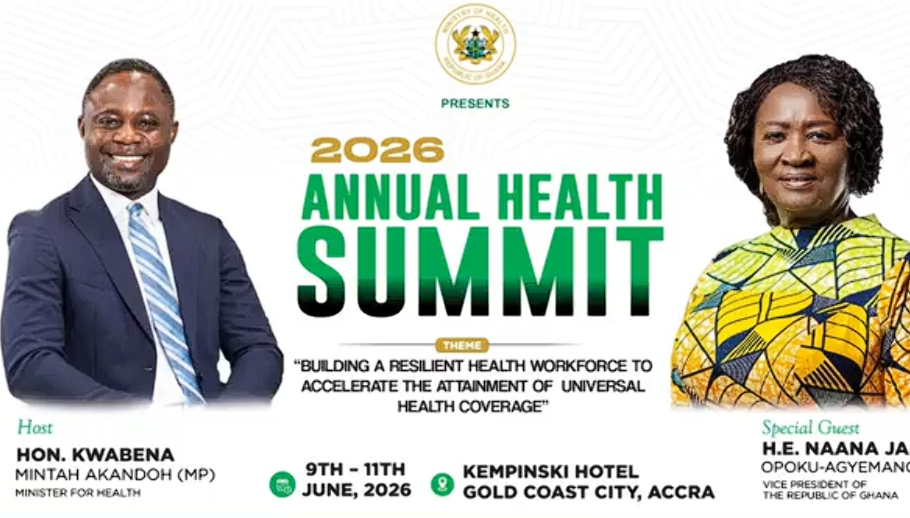
Ghana’s Ministry of Health is set to convene its 2026 Annual Health Summit, bringing together health professionals, policymakers, development partners, academics and other key stakeholders to deliberate on strategies for strengthening the country’s healthcare system.
The summit, which serves as the ministry’s flagship platform for health sector dialogue, will this year place particular emphasis on workforce resilience and the nation’s progress toward Universal Health Coverage — two issues that have dominated health policy discussions in Ghana over the past several years.
Health workforce challenges remain among the most pressing constraints facing Ghana’s health sector. The country continues to grapple with an uneven distribution of health professionals, with rural and underserved communities bearing the brunt of staffing shortages even as urban centres absorb the majority of trained personnel. The emigration of Ghanaian health workers to wealthier nations has further intensified the domestic shortage, prompting repeated calls for retention strategies that go beyond salary adjustments.
The summit comes at a critical juncture. Earlier this year, Health Minister Kwabena Mintah Akandoh confirmed that all 13,500 nurses recruited into Ghana’s public health system had been placed on the government payroll, with outstanding arrears expected to be settled by July. That development, while significant, underscored the broader challenge of retaining health workers amid competing demands from the private sector and international recruitment drives that continue to draw Ghanaian professionals abroad.
Universal Health Coverage has long been a stated priority for successive Ghanaian governments, yet implementation has progressed unevenly. The National Health Insurance Scheme, which was designed to bring the country closer to UHC goals, has faced persistent funding gaps, delayed reimbursements to service providers, and uneven geographic coverage that leaves many Ghanaians — particularly those in the informal sector — without reliable access to essential services.
Health policy analysts expect the summit to generate concrete recommendations on expanding primary healthcare infrastructure, improving supply chain management for essential medicines, and deploying digital health technologies to bridge gaps in service delivery. The growing role of community health workers, particularly through the CHPS compound network, is also likely to feature prominently in discussions.
Development partners and multilateral organisations have in recent years intensified their engagement with Ghana’s health sector, and the summit provides a structured forum for aligning donor priorities with national health strategies. The event is expected to attract participation from the World Health Organisation, the Africa Centres for Disease Control and Prevention, and several bilateral development agencies.
The discussions will also touch on lessons learned from recent public health emergencies, including the country’s ongoing preparedness efforts. Africa’s health security architecture has been a growing area of focus, with continental bodies increasingly urging member states to invest in domestic health system resilience rather than relying solely on external support during crises.
For Ghana, the summit represents an opportunity to take stock of where the health sector stands and chart a realistic course toward the twin goals of a resilient workforce and genuine universal coverage — objectives that, if achieved, would transform healthcare access for millions of citizens.
Image Source: MYJOYONLINE