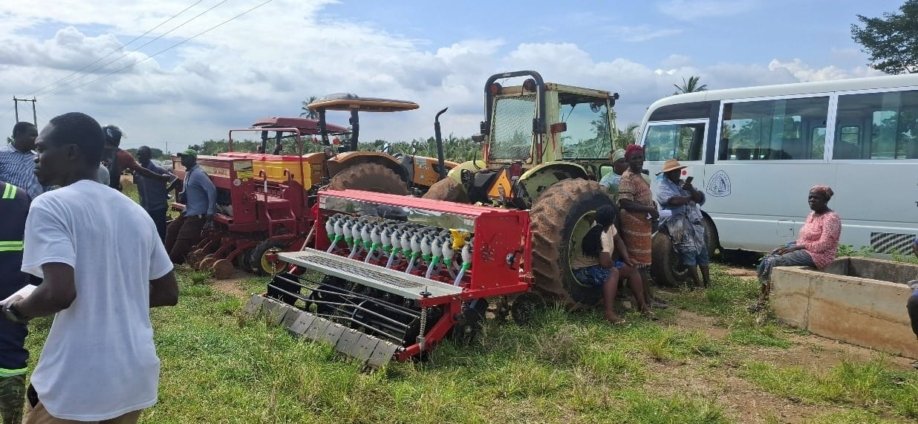
Ghanaian rice farmers could soon see a reduction in production costs thanks to a field demonstration of labour-saving technologies hosted by the Ghana Rice Production Improvement Project (GRIP) at the Kpong Irrigation Scheme (KIS).
The event, a collaboration between GRIP, the Agricultural Engineering Services Directorate (AESD) of the Ministry of Food and Agriculture (MoFA), and the GIZ-supported Market-Oriented Value Chains for Jobs and Growth in the ECOWAS Region (MOVE), showcased advanced mechanisation aimed at addressing the high costs and labour shortages plaguing the local rice industry.
Currently, Ghana imports around 950,000 tons of rice annually, largely due to the price competitiveness of Asian varieties. Local farmers struggle with rising machinery fees and a dwindling workforce as young people seek opportunities in other sectors.
“Heavy reliance on manual labour for activities like ploughing, seeding, and harvesting significantly increases production costs, often making Ghanaian rice as expensive or even more expensive than imports,” explained a representative from MoFA who attended the demonstration.
GRIP introduced a range of equipment including dry-field direct seeders, no-till dry-field direct seeders, wet-field direct seeders, drone seeders, and drive harrows. These technologies are designed to simplify land development, improve soil preparation, reduce labour requirements, and enhance post-harvest efficiency.
A key innovation presented was a flat-bed paddy dryer, locally fabricated based on a design by the International Rice Research Institute (IRRI). This dryer offers a faster and less labour-intensive alternative to traditional sun-drying methods.
The demonstration wasn’t just about showcasing equipment; it facilitated direct engagement between machinery manufacturers, service providers, and farmers. The goal is to promote the adoption of these technologies and develop sustainable business models for their accessibility across Ghana’s rice-growing regions.
Stakeholders believe that wider adoption of these labour-saving technologies is crucial for achieving Ghana’s rice self-sufficiency goals and ensuring a more competitive local rice industry.
Image Source: MYJOYONLINE