Trump's Gaza Peace Plan Hits Roadblock Amid Israeli and Hamas Challenges
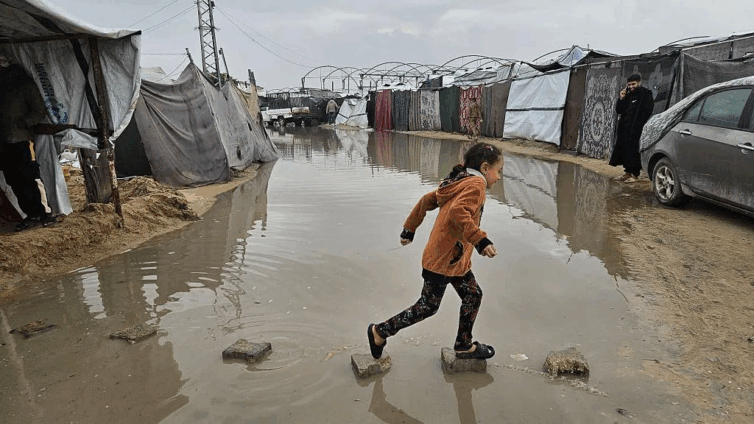
Gaza City – A persistent trickle of water seeps through the makeshift shelter shared by Ghadir al-Adham, her husband, and their six children. Displaced by the recent conflict, the family remains in limbo, awaiting the commencement of reconstruction efforts.
“Here we are, living a life of humiliation,” Ms. al-Adham lamented. “We need proper caravans, we need our homes rebuilt. We long for concrete walls to shield us from the cold.” Her voice, heavy with despair, reflects the daily struggle of countless Gazans.
Two months after an American-brokered ceasefire, Gaza finds itself stalled in the initial phase of former US President Donald Trump’s peace plan. The territory remains fractured, its people surrounded by the remnants of war and a pervasive sense of uncertainty.
A powerful winter storm has exacerbated the already dire situation, causing widespread flooding in displacement camps and the collapse of several structures. The United Nations estimates that over 800,000 Gazans are now at risk of flooding, adding another layer of hardship to their lives.
Hostage Search Stalls Peace Process
Progress on rebuilding homes and establishing a new government is contingent on the resolution of a critical sticking point: the search for Ran Gvili, an Israeli hostage. Israeli Prime Minister Benjamin Netanyahu has firmly stated that Hamas must return all hostages – both living and deceased – before advancing to the next, more complex stage of the peace deal.
Despite numerous searches through the rubble of Gaza, Mr. Gvili remains unaccounted for. He was captured during the Hamas attacks on October 7th, while attempting to defend the kibbutz Alumim, despite recovering from a broken shoulder.
His parents, Talik and Itzik, were informed last year that their son was presumed dead. Banners honoring Mr. Gvili line the road to their home in Meitar, southern Israel, alongside yellow flags symbolizing the plight of the hostages.
“They stole our kid, they stole him,” Ms. Talik said, her voice filled with anguish.
“They know where he is, they just try to hide or keep him. They’re playing with us,” added Mr. Itzik, expressing frustration and suspicion.
The family believes Hamas may be holding Mr. Gvili as leverage for future negotiations, intending to release him only after securing concessions. Hamas officials, however, have refuted these allegations to the BBC, claiming Israel is deliberately obstructing the implementation of the agreement.
With no concrete evidence of Mr. Gvili’s fate and mounting pressure from Washington, his parents are desperately hoping for a breakthrough. “Everyone in Israel’s government says to us, ‘No, we don’t move to the second level until Ran comes back.’ This is their promise,” Ms. Talik stated.
Analysts suggest that a continued search for hostages could prove politically challenging for Netanyahu, particularly when considering the withdrawal of Israeli forces from Gaza’s perimeter.
Time is of the Essence
The next phase of the deal requires significant concessions from both sides. Hamas would need to disarm and relinquish power, while Israel would have to entrust security to an international stabilization force.
Retired General Israel Ziv, a former head of Israel’s military Operations Directorate, believes both parties are hesitant to move forward. “Israel and Hamas share an interest in not accelerating into the second stage,” he explained. “Hamas doesn’t want to lose control, and the Israeli side, for political reasons, prefers to maintain a presence in Gaza, as explaining a withdrawal to their supporters would be difficult.”
General Ziv emphasized the urgency of the situation, stating, “By waiting, we risk missing the opportunity because Hamas is reorganizing and regaining strength. We have to take a deep breath and proceed with the plan, as the current situation is the worst-case scenario.”
Disarming Hamas remains a primary obstacle. Without a credible disarmament process, foreign nations are unlikely to commit troops to secure the Strip, and reconstruction efforts in Hamas-controlled areas will likely remain stalled.
Netanyahu recently expressed skepticism about the ability of international forces to fully replace Israel’s security role. “Our friends in America want to try to establish an international force that will do the job,” he said. “We know that there are certain tasks that this force can do. I don’t want to go into detail, they can’t do everything, and maybe they can’t do the main thing, but we’ll see.”
Trump Pushes for Progress
Gaza is currently bisected by a “yellow line” demarcating the limits of Israeli forces under the ceasefire agreement. Some have interpreted this as a signal of Israel’s intention to establish a long-term presence in the area.
Key issues, including the disarmament of Hamas, are scheduled for discussion at a meeting between Netanyahu and Trump in Florida later this month. The US president, who brokered the ceasefire and championed his peace plan at the UN Security Council, has publicly voiced his desire to expedite the process.
“I will announce the membership of a newly created Board of Peace for Gaza early next year. It will be one of the most legendary boards ever… Everybody wants to be on it,” Trump told journalists this week.
Reports indicate that, under pressure from Washington, Israel has begun clearing rubble in the Israeli-held area of Rafah, in southern Gaza, to prepare for a new temporary housing project. This project would reportedly offer shelter to tens of thousands of Gazans, contingent on their willingness to relocate to Israeli-held areas and undergo security checks.
Some view this as a strategy to isolate Hamas by attracting Gazans to Israeli-controlled territory. A small number of individuals have already crossed into these areas, finding refuge in camps supported by armed groups aligned with Israel.
However, many Gazans, even those seeking an alternative to Hamas, have expressed their refusal to live under Israeli control. This situation paints a stark picture of a potential future for Gaza – one of deepening division if the second stage of Trump’s plan fails to materialize.
Image Source: MYJOYONLINE