Ghana and US Strengthen Partnership Under New Policy
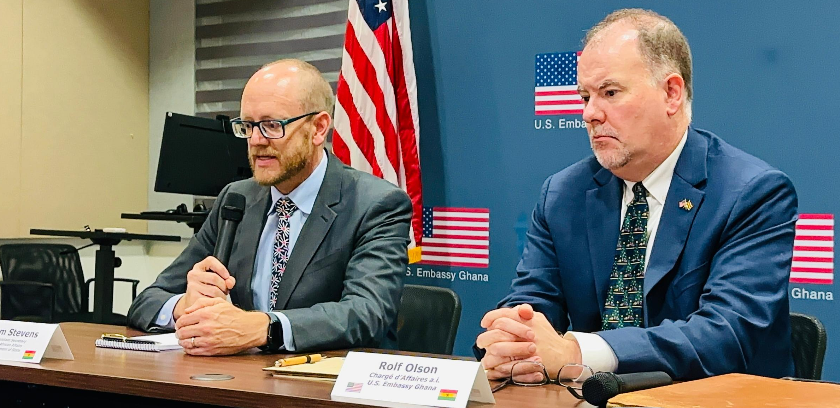
The United States Government has announced a new phase in its partnership with Ghana, with a sharpened focus on expanding trade, attracting strategic investment, ensuring health sustainability, and bolstering security cooperation.
This recalibration of U.S. engagement with Africa prioritises mutual benefit and a move away from traditional aid dependency, officials say.
Speaking at a policy interaction in Accra, Deputy Assistant Secretary for West Africa at the U.S. Department of State’s Bureau of African Affairs, Will Stevens, affirmed Ghana’s position as a key partner in West Africa. He cited consistent high-level dialogue, increasing trade volumes, and a strong alignment with U.S. policy objectives under the current administration as reasons for this continued prioritization.
Mr. Stevens revealed that U.S.-Ghana trade has seen significant growth in recent years, jumping from approximately US$2 billion to between US$3.5 billion and US$4 billion. He highlighted that many Ghanaian exports, including oil and cocoa, benefit from tariff exemptions when entering the American market, placing Ghana among nations with the lowest trade barriers with the U.S.
“That reflects the strength of our relationship and the balanced nature of trade between our two countries,” Mr. Stevens stated. He added that the U.S. is keen to see Ghanaian markets open further to American goods, fostering a reciprocal partnership built on equality.
Regarding the African Growth and Opportunity Act (AGOA), Mr. Stevens explained the U.S. administration is seeking a one-year extension to allow for the development of a new trade framework that addresses current global economic realities.
He emphasized a shift towards trade as the central pillar of U.S. engagement with Africa, supported by government tools designed to stimulate private sector investment. The Lobito Corridor initiative, a public-private partnership involving the U.S. Development Finance Corporation, the Export-Import Bank, the World Bank, and private investors, was presented as a successful model for regional integration through improvements in rail, logistics, technology, and infrastructure.
“These are the kinds of projects where U.S. government engagement can be catalytic, making it possible for private sector investment to flow at scale,” he said, expressing hope for similar expansions across West Africa.
On the topic of investment, Mr. Stevens highlighted the U.S. commitment to building local capacity. He pointed to Newmont Corporation, Ghana’s largest taxpayer, as an example, noting that the company is led by a Ghanaian national.
“That is exactly what we mean by investing in host-country nationals and national leadership,” he said, describing it as a demonstration of partnership rather than dominance.
The U.S. is also negotiating a bilateral Memorandum of Understanding (MoU) with Ghana to establish a clear path for future health financing. This comes after the integration of USAID functions into the State Department. Health has historically been the largest area of U.S. assistance to Ghana, particularly in programs addressing malaria and HIV/AIDS.
“This reflects our recognition that stopping assistance suddenly would be detrimental, but also that long-term responsibility for healthcare rests with national governments,” Mr. Stevens explained, adding that President John Dramani Mahama’s views on the matter align closely with U.S. thinking.
Addressing concerns about potential restrictions on U.S. assistance due to Ghana’s sovereign debt defaults, Mr. Stevens clarified that the issue pertains to legacy arrears with the U.S. Export-Import Bank. He stated that both governments are actively engaged in bilateral debt restructuring talks, which have been productive, with Ghana having made several payments in recent months.
“As long as there is a bilateral default, the law restricts additional government-to-government financing, but we are hopeful that this will be resolved soon,” he said.
Mr. Stevens commended Ghana’s cooperation on migration and security, noting its constructive role in supporting U.S. efforts to enforce immigration laws while upholding due process. He stated that Ghana’s responsiveness and openness have made it “easy to do business” with, solidifying its position as a trusted U.S. partner.
U.S. Embassy Chargé d’Affaires Rolf Olsen described bilateral cooperation as “extraordinary,” particularly in law enforcement and the rule of law. He highlighted Ghana’s extradition of nine individuals to the U.S. within a year, largely related to cybercrime and large-scale financial fraud targeting vulnerable individuals, as a significant demonstration of judicial and political commitment.
“Cybercrime does not respect borders, and the level of collaboration we have seen from Ghanaian authorities has been very strong, very efficient, and very effective,” Mr. Olsen said, praising Ghana’s security and justice institutions.
Mr. Olsen expressed confidence in Ghana’s ability to manage its international obligations responsibly, emphasizing the shared values and mutual respect underpinning the U.S.-Ghana partnership. He affirmed the U.S.’s continued support for Ghana as a key democratic and strategic partner in West Africa.
Image Source: MYJOYONLINE