The Ghana Immigration Service (GIS) and the European Union have formalised a new security partnership aimed at bolstering border management and counter‑terrorism across Ghana’s northern frontiers and the volatile Sahel region.
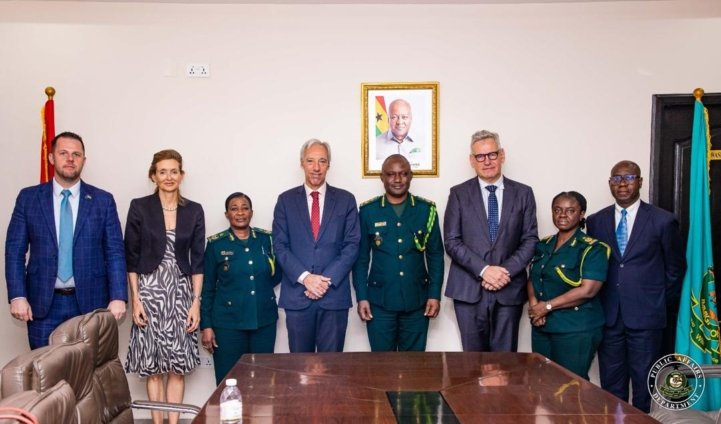
The high‑level talks took place in Accra earlier this week, led by EU Special Representative for the Sahel Juan Crauvino and EU Ambassador to Ghana Rune Skinnebach. They met with GIS leadership to map out joint actions.
“Ghana is a strategic partner whose security realities we must understand,” Crauvino said, stressing the need for close collaboration with all 27 EU member states.
He praised Ghana’s resilience, noting that local initiatives have kept terrorist incursions at bay despite the extreme volatility in the broader Sahel.
Comptroller‑General of Immigration Samuel Basintale Amadu warned that the Sahel’s growing instability is pressing down on Ghana, describing the region as a “security concern that sits on top of Ghana.”
Amadu highlighted the unique challenges of the roughly 500 km northern border, where boundaries sometimes cut through houses, allowing criminals to blend in with residents. He added that limited mobility hampers effective patrols and rapid response.
EU Ambassador Rune Skinnebach confirmed that sixty percent of the EU’s financial and technical assistance is directed to the north, reflecting “our awareness of the challenges there.” He applauded the progress of the EU Security and Defence Initiative (EUSDI) in enhancing surveillance technology and inter‑agency coordination.
Deputy Comptroller‑General for Operations and Command Post Laud Affrifah urged further investment in surveillance equipment, rapid‑response mechanisms and officer training, citing the ethnic and geographic complexities of the northern frontier.
Affrifah noted that past operations such as “Operation Conquered Fist” have strengthened multi‑agency presence, but emphasized that more technology and training are essential to sustain stability.
Amadu expressed deep appreciation for EU backing, citing support from the International Centre for Migration Policy Development, the International Organisation for Migration and other EU‑funded initiatives.
Concluding the meeting, Crauvino described the dialogue as “constructive and encouraging,” reaffirming the EU’s commitment under the EUSDI framework and broader EU‑Africa security arrangements.
The partnership aims to build a resilient security architecture capable of countering the escalating threats emanating from the Sahel, while bolstering community‑level engagement that has proven vital in preventing radicalisation.
Image Source: MYJOYONLINE